Languages
SIR
For the 16+ project, for teaching, Hoskyns chose to make use of Elliott's Symbolic Input Routine (SIR) assembly language, one of the languages that was available on their Elliott 903 computer. This was the main assembly language for the 903 range. The team wanted pupils to learn a low-level language so that they were not "isolated from the computer", and chose SIR because it had only 16 functions, was considered educationally sound, and ran on a machine that also had Algol and Fortran compilers for later work.
SIR and the Elliott 903: Computer Conservation Society
CESIL
CESIL, the CES Instructional Language, was a simplified low-level assembly language developed for educational use. The Schools Council's file on the project (UCL Institute of Education Archives, SCC/355/363/014) shows that it began under Hoskyns, not ICL, as part of the 16+ course. In February 1969 the project's panel of local education authority advisers was discussing a "fictitious language" in the draft textbook. A paper from April 1969 explains that CESIL was originally specified as an ideal language to use as a "yard stick", and was run through a translator rather than a full compiler. The 16+ pupils' book introduced programming in CESIL before moving on to SIR.
CESIL quickly became the language pupils actually used. By December 1969, after ICL had taken over, schools had sent in about 850 CESIL programs against 300 in SIR. When ICL began developing material for 16- students, CESIL was carried forward: a draft CSE syllabus that December proposed one book based on CESIL and a second on BASIC.
An April 1971 comparison of the CES and NCC packages in Computer Education (No. 7, p. 14) found CESIL an excellent introduction to programming for beginners, with an easy step on to SIR, though the CES course was limited to ICL machines.
A CES catalogue from about 1977 set out the case for CESIL: it closely resembled students' step-by-step reasoning, needed no algebra, let students write working programs after very little teaching, and showed the operations that lie beneath high-level language statements. Because coding in CESIL was so simple, more emphasis could go on logical thinking and flowcharting (Goldstein papers, GG/8/5).
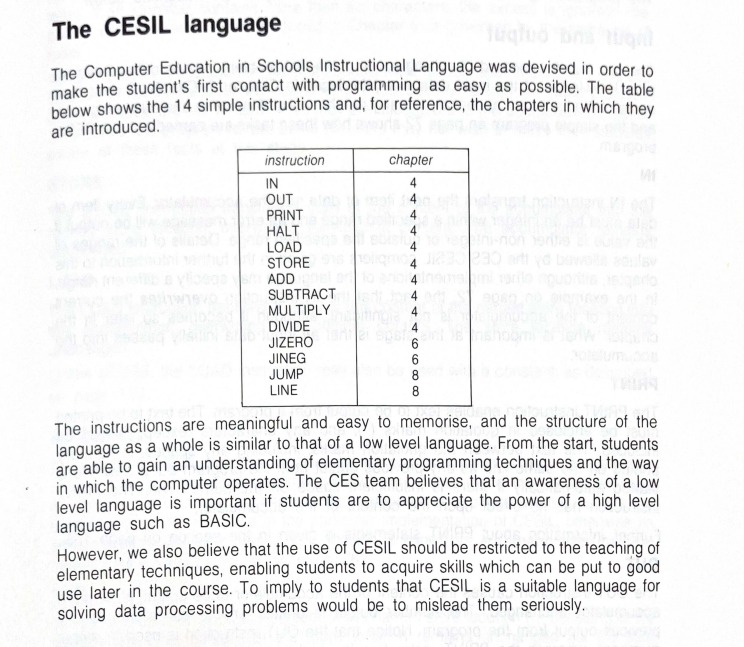
Part of CESIL's appeal was its size: just fourteen instructions. On a 1975 CES course for children aged 11 to 16, the instructions were explained on the first afternoon and "readily grasped" (Newsletter No. 26, March 1976).
Here's a page from the Revised Book 1 16- teachers guide that explains their thought process with CESIL.
Running CESIL
The newsletters show how the way CESIL programs were run changed over the life of the project:
- 1969: pupils' programs were run on a simulator on ICL 1900 series computers, which was "in full swing" from 6th October 1969 (Newsletter No. 1).
- 1970: ICL Deutschland adapted the simulator so that CESIL programs could be marked up on Universal Document Transport (UDT) forms and read by an optical mark reader, skipping the slow card or tape punching stage. It was demonstrated at the Hanover Fair, where visiting schoolchildren wrote programs, marked up the forms and watched them run (Newsletters No. 6 and 7).
- 1971: a new CESIL compiler was produced "in time for next year's courses". It added the
PRINTandLINEinstructions, listed the program in columns, and simplified the error messages (Newsletter No. 11). The early CESIL compiler had had noPRINTstatement and printed every number on a new line. John Hammond, who joined CES in 1971, taught himself PLAN (the ICL 1900 assembly language) and rewrote the CESIL compiler to an enhanced specification, followed by a SIR compiler with much clearer error messages (Newsletter No. 28, January 1977). - 1973: the CES Software Directory listed CESIL and SIR compilers for any machines, along with BASIC compilers for ICL machines (November 1973 newsletter).
- 1976: local variations appeared. Dyfed County Council's Educational Computer Centre ran a system for batching up CESIL and BASIC programs on magnetic tape, also available for SIR and for DEWI, a Welsh version of CESIL (Newsletter No. 26). Another computer centre offered a modified CESIL compiler for interactive use, and a pupil there wrote an interactive version of CESIL in FORTRAN (Newsletter No. 27).
- 1977–79: others outside CES wrote their own CESIL systems, and articles in Computer Education described several of them. EXCESIL, by Peter Harris of Warley College of Technology, was an extended CESIL for A level written in BASIC, with ICL CESIL as a subset; the article showed it running on a PDP-8 (No. 27, November 1977). MICRO-CESIL, by Chris Robinson of LEASCO Software, Maidenhead, was an interactive CESIL compiler for a microcomputer (No. 28, February 1978). Sandhurst School developed a CESIL system for the RML 380Z microcomputers being supplied to Berkshire schools, designed to run the programs in the ICL-CES books in 16k of memory (No. 32, June 1979).
- 1979: writing in the ILEA Computer Studies Newsletter, Judy Challinor of Sir John Cass and Redcoat School said she taught CESIL first, even though it was not part of the O level syllabus, because it made BASIC easier and helped pupils tell low-level from high-level languages. Her advice was not to spend more than "1–1¼ terms on CESIL before weaning them to BASIC" (No. 23, Summer 1979).
- Early 1980s: in "Who's using CESIL?", Bryan Weaver of the ILEA argued that CESIL's role needed re-evaluating. Teachers were mixing CSE and O level classes, the 1983 LREB syllabus made CESIL optional, and microcomputers gave pupils far more direct experience of a computer than a time-sharing system. He suggested that a subset of a real assembly language, such as ZASM on the RML 380Z, might teach low-level ideas better, and asked to hear from teachers who had replaced CESIL with a BASIC course for less able pupils (ILEA Educational Computing Newsletter No. 30, pp. 38–39).
- 1990: an article in Computer Education noted that CESIL had "fallen from favour" and that the GCSE syllabus had moved away from it (No. 65, June 1990).
BASIC
BASIC was used alongside CESIL in the 16- course from Computer Studies Book 2 onwards, and became increasingly important as more schools gained on-line terminals.
ICL's own BASIC compiler at the time could only run on a large computer, much larger than most of those in the technical colleges that ran schools' programs. John Hammond set out to write a small, efficient BASIC compiler, with help from Teresa Wilson, a Brighton Polytechnic student on placement with CES in 1972, who surveyed the BASIC compilers then available and wrote a specification. Software writers had reportedly estimated the job at "six man-years, at least"; John had a working compiler after little more than one (Newsletter, September 1972; Newsletter No. 28, January 1977).
The compiler was called #JBAS:
- #JBAS Mark 1 was completed in December 1973 and handled numeric programming. It was designed for small machines and could be run in batch or interactive mode (March 1974 newsletter; Newsletter No. 25).
- #JBAS Mark 2 (1975) added character string handling, to support the more information-processing approach of Book 3, and commands for interactive users. It was sent to over 100 installations providing a computing service to schools (May 1975 newsletter; Newsletter No. 25).
- #JBAS Mark 3 was built after John left CES in 1976, to his specification, by ICL's Contract Programming Services. It added comprehensive file handling and formed the heart of the CES BASIC System, generally available from 1979, which ran on ICL 1900 series and 2903/4 computers, and on 2900 series machines under DME (Newsletters No. 28 and 33). The CES Advisory Council minutes show how long it took. ICL's Education Region decided to add file handling in February 1976, with John Hammond defining the facilities and a contract programmer writing the code. In June 1976 some panel members objected to ICL's new policy of charging for the compiler, since schools were used to free software. Testing was due to start in December 1976, but in October 1977 the compiler was still not working, and CES had pressed Contract Programming Services to assign a programmer who knew another ICL BASIC compiler. Queen Mary College helped with testing (GG/8/5).
CES distributed its software itself, including #JBAS, #JCES, #JSIR and #TCES (Newsletter No. 29, May 1977).
Copies of the ILEA newsletters are in the Goldstein papers (GG/2/2), UCL Institute of Education Archives.
Find out more
Ian Dunmore has already done an excellent job of explaining CESIL on his website, and I advise you to read this.